




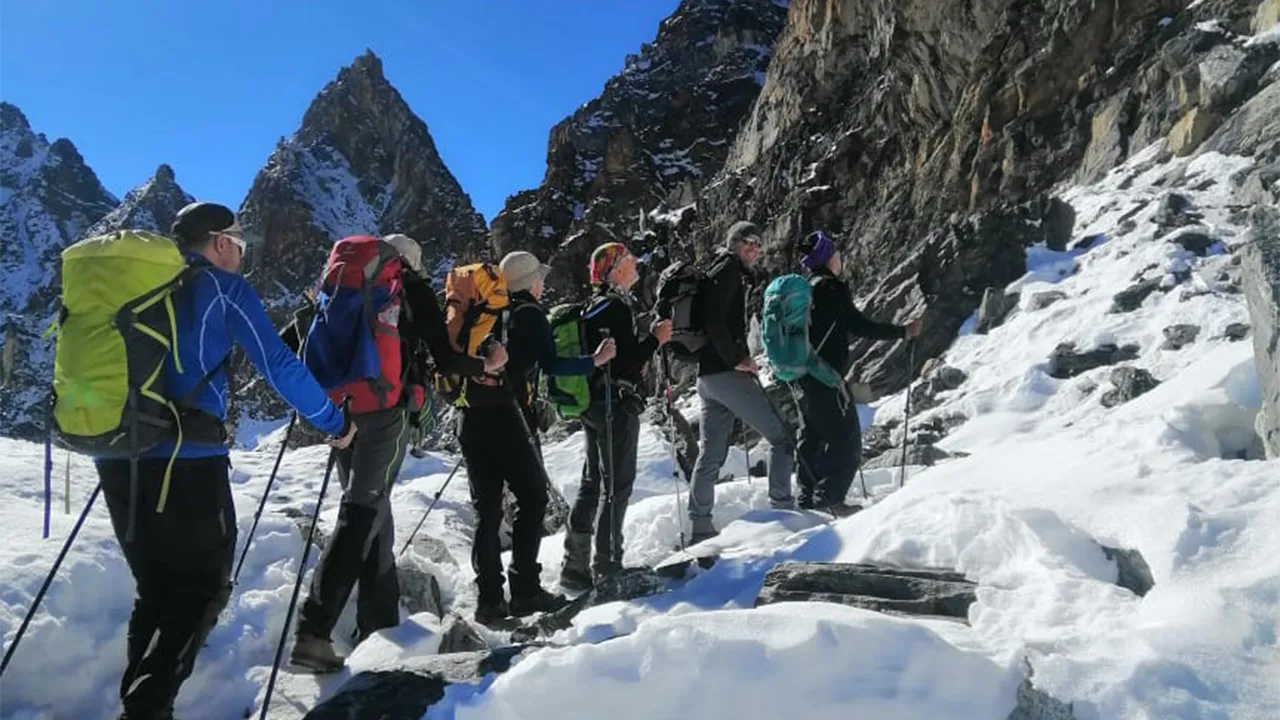
Cross Kongma La, Cho La and Renjo La in one unforgettable Himalayan journey
The Everest Three High Passes Trek is the Khumbu region’s ultimate trekking circuit. In one journey you cross three passes above 5,300 m, stand at Everest Base Camp, climb Kala Patthar for a sunrise over the world’s highest peak and walk beside the turquoise Gokyo Lakes. It is longer, higher and tougher than the classic Everest Base Camp trek, and for experienced trekkers it is one of the most rewarding routes in Nepal.
This guide covers how hard the trek really is, the full 20-day itinerary, permits, cost, the best season, training and safety. For dates and booking, see our Everest Three High Passes Trek page.
Everest Three High Passes Trek at a Glance
| Detail | Information |
|---|---|
| Region | Khumbu (Everest region), Nepal |
| Duration | 20 days, Kathmandu to Kathmandu |
| The three passes | Kongma La (5,535 m), Cho La (5,420 m), Renjo La (5,360 m) |
| Highest point | Kala Patthar (5,545 m) |
| Other highlights | Everest Base Camp (5,364 m), Gokyo Lakes, Gokyo Ri (5,357 m) |
| Difficulty | Challenging to strenuous |
| Accommodation | Hotel in Kathmandu, tea houses on the trail |
| Best seasons | March to May and September to November |
| Group size | 1 to 30 |
| Price | From €2,050 per person |
Why Trek the Three High Passes?
- Three passes, three different worlds. Kongma La, Cho La and Renjo La each offer a different view, from the Khumbu Glacier to the Ngozumpa Glacier and the Gokyo valley.
- The best of the Khumbu in one trip. You combine Everest Base Camp, Kala Patthar and Gokyo Ri in a single route.
- Quieter trails. The sections between passes are far less crowded than the standard Everest Base Camp trail.
- Giant views. Everest, Lhotse, Nuptse, Makalu, Cho Oyu, Ama Dablam and Pumori appear again and again.
- Living Sherpa culture. You pass Namche Bazaar, Tengboche Monastery, Pangboche, Dingboche and Gokyo.
- A true achievement. Completing all three passes is a milestone many trekkers talk about for years.
How Difficult Is the Everest Three High Passes Trek?
The Three Passes trek is challenging to strenuous. It is not technical, but it is long, high and demanding, and it asks for steady fitness, good altitude habits and mental toughness.
| Challenge | What You Face |
|---|---|
| Time at altitude | Many days above 4,500 m, with nights at 4,730 m, 4,910 m, 5,170 m and 4,750 m |
| Long pass days | Pass crossings take roughly 8 to 10 hours, starting before sunrise |
| Terrain | Steep moraine, loose rock, snow and an icy ridge on Cho La |
| Cold | Freezing mornings, wind and cold nights in tea houses |
| Remote sections | Fewer lodges between passes, with simple facilities |
| Altitude sickness risk | Prolonged time above 5,000 m raises the risk, even for fit trekkers |
Three Passes vs Everest Base Camp: What’s Different?
| Feature | Everest Base Camp Trek | Everest Three High Passes Trek |
|---|---|---|
| Duration | About 15 days | About 20 days |
| Passes | None | Three (above 5,300 m each) |
| Time above 5,000 m | Limited | Extended |
| Daily walking | Moderate | Several 8 to 10 hour days |
| Crowds | Busy | Quieter between passes |
| Experience needed | Some trekking experience | Strong previous high-altitude trekking |
Who it suits: fit trekkers with previous multi-day, high-altitude experience who want a bigger challenge than the standard Everest Base Camp Trek. If you are new to trekking, start with that route first.
20-Day Everest Three High Passes Itinerary
| Day | Route | Altitude | Highlights |
|---|---|---|---|
| 1 | Arrive in Kathmandu | 1,400 m | Welcome and briefing |
| 2 | Sightseeing and preparation | 1,400 m | Gear check, optional heritage tour |
| 3 | Fly to Lukla, trek to Phakding | 2,610 m | Dudh Koshi valley, prayer flags |
| 4 | Phakding to Namche Bazaar | 3,440 m | Sagarmatha National Park, Hillary Bridge |
| 5 | Acclimatization in Namche | 3,440 m | Everest View Hotel hike, Sherpa culture |
| 6 | Namche to Tengboche | 3,860 m | Tengboche Monastery, Ama Dablam views |
| 7 | Tengboche to Dingboche | 4,410 m | Pangboche Monastery, Imja Valley |
| 8 | Acclimatization in Dingboche | 4,410 m | Nangkartshang ridge hike (4,600 m) |
| 9 | Dingboche to Chhukung | 4,730 m | Optional Chhukung Ri (5,550 m) |
| 10 | Cross Kongma La to Lobuche | 5,535 m / 4,910 m | First high pass |
| 11 | Lobuche to Gorak Shep, Everest Base Camp | 5,170 m / 5,364 m | Khumbu Glacier, Base Camp |
| 12 | Kala Patthar sunrise, return to Lobuche | 5,545 m | Panorama of Everest and Nuptse |
| 13 | Lobuche to Dzongla | 4,830 m | Gentle day before Cho La |
| 14 | Cross Cho La to Gokyo | 5,420 m / 4,750 m | Second pass, Ngozumpa Glacier |
| 15 | Rest day, Gokyo Ri and lakes | 5,357 m | Turquoise Gokyo Lakes |
| 16 | Cross Renjo La to Lumde | 5,360 m / 3,900 m | Third pass, Gokyo views |
| 17 | Lumde to Namche Bazaar | 3,440 m | Return to the Sherpa capital |
| 18 | Namche to Lukla | 2,860 m | Final trekking day |
| 19 | Fly to Kathmandu | 1,400 m | Mountain flight views |
| 20 | Departure | n/a | Airport transfer |
Key Days Explained
Days 5 and 8, acclimatization. Rest days at Namche Bazaar and Dingboche help your body adapt. Use them properly with short hikes and plenty of fluids.
Day 10, Kongma La. A long climb over rocky, glacial terrain takes you to the highest of the three passes at 5,535 m before descending to Lobuche. Expect 8 to 9 hours.
Days 11 and 12, Base Camp and Kala Patthar. You reach Everest Base Camp, then climb Kala Patthar for sunrise over Everest, Lhotse and Nuptse.
Day 14, Cho La. A steep climb leads to an icy ridge near the top, then a long descent to Gokyo. Allow 9 to 10 hours and watch your footing.
Day 15, Gokyo Ri. A rest day with an optional climb to Gokyo Ri (5,357 m), where Everest, Lhotse, Makalu and Cho Oyu sit above the Ngozumpa Glacier.
Day 16, Renjo La. The final pass at 5,360 m rewards you with views back over the Gokyo Lakes, then a long descent to Lumde.
See the day-by-day details on our trip page.
Altitude and Acclimatization on Three High Passes
The Three Passes trek spends a long time high, so acclimatization is the foundation of success.
- Follow the rest days. Namche, Dingboche and Gokyo are built into the itinerary for a reason.
- Climb high, sleep low. Day hikes such as Nangkartshang and Gokyo Ri help your body adapt.
- Walk slowly. A steady, slow pace beats speed at altitude.
- Drink 3 to 4 liters daily and eat regularly, even when appetite drops.
- Report symptoms early. Headache, nausea, dizziness or poor sleep are warning signs.
- Avoid alcohol and sleeping pills at altitude.
- Know the danger signs. Breathlessness at rest, a wet cough, confusion or loss of coordination mean immediate descent.
- Accept your guide’s decisions. Delaying or skipping a pass is sometimes the right call.
Discuss altitude medication with your doctor before travel.
Everest Three High Passes Trek Permits and Costs
Permits
| Permit | Approx. Cost |
|---|---|
| Sagarmatha National Park entry | NPR 3,000 (about USD 22) |
| Khumbu Pasang Lhamu Rural Municipality fee | NPR 2,000 (about USD 15) |
The trek does not need a special restricted-area permit. Fees and requirements change, so we confirm current rates for you before departure. We arrange all permits, so you only provide your passport copy and photos.
Everest Three High Passes Trek Cost
Our Everest Three High Passes Trek starts from €2,050 per person. The final price depends on group size, season, flights, accommodation standard, whether you hire a porter and any customization. Contact us for a written quote for your dates.
| Cost Factor | How It Affects the Price |
|---|---|
| Group size | Larger groups share guide and logistics costs |
| Season | Spring and autumn are busiest |
| Flights | Kathmandu to Lukla and back, including Ramechhap routing in peak season |
| Porters | Optional porters add to the cost |
| Hotels | Kathmandu hotel standard and extra nights |
| Customization | Extra rest days, private departure, helicopter options |
What Is Typically Included
- Professional trekking guide and support staff
- Tea house accommodation along the route
- Breakfast, lunch and dinner during the trek
- Trekking permits (national park entry)
- Airport transfers in Kathmandu and transport to the trailhead
- Optional porters, if arranged
- First-aid kit and emergency support
- Pre-trek briefing in Kathmandu
Please confirm flights, Kathmandu hotels and sightseeing in your written quote.
What Is Not Included
- International flights and Nepal visa
- Travel insurance (mandatory, including helicopter evacuation)
- Personal gear such as sleeping bag, jacket, poles and crampons if needed
- Snacks, drinks, hot showers and souvenirs
- Tips for guides and porters
- Optional activities outside the itinerary
Best Time for the Three High Passes Trek
| Season | Months | What to Expect |
|---|---|---|
| Spring | March to May | Rhododendrons in bloom, warmer days, good views |
| Autumn | September to November | Clear skies, stable weather, the best mountain views |
| Winter | December to February | Very cold, with snow and ice on the passes |
| Monsoon | June to August | Rain, cloud and slippery trails |
For most trekkers, late September to early November and mid-April to mid-May are the ideal windows. Pass conditions vary with snow and ice, so your guide decides daily whether to cross.
How to Train for the Three High Passes
Start 16 to 20 weeks before departure, because the trek demands endurance for many long days.
| Phase | Weeks | Focus | Weekly Plan |
|---|---|---|---|
| 1. Base | 1–5 | Build routine and aerobic base | 3 cardio sessions (40–60 min), 2 strength sessions, 1 easy hike |
| 2. Strength | 6–10 | Leg strength and endurance | 3–4 cardio sessions, 2 strength sessions, 1 hike (3–5 hrs) |
| 3. Trek-specific | 11–16 | Long days with a loaded pack | Stair or hill sessions, 1 long hike (5–7 hrs) with 7 to 8 kg, plus a second hike the next day |
| 4. Taper | 17–20 | Rest and prepare | Reduce volume, keep short sessions, check gear |
Key training elements:
- Stair and hill work for steep ascents like Kongma La and Cho La
- Downhill practice with poles to protect knees on long descents
- Back-to-back long days to prepare for repeated pass crossings
- Core and leg strength for rocky and icy ground
- Cold-weather outings to test your layers and gloves
- Mental preparation for early starts and basic tea-house life
What to Pack for Everest Three High Passes Trek
- Sleeping bag rated to about -15°C to -20°C
- Down jacket, fleece, waterproof shell and thermal layers
- Broken-in waterproof boots with ankle support
- Trekking poles, gaiters and a headlamp
- Microspikes or light crampons for icy sections (ask your guide about conditions)
- Sunglasses with side protection, warm gloves and a warm hat
- Water purification, first-aid items and a power bank
Our trekking equipment guide has the full checklist, and many items can be rented in Kathmandu.
Insurance and Safety
Insurance is mandatory and must cover trekking above 5,500 m and emergency helicopter evacuation. Read our guides to travel insurance, emergency rescue and helicopter evacuation in Nepal and helicopter rescue in Nepal, and see our first aid information.
Other Everest Region Treks to Consider
If the Three Passes trek feels like too much, or you want to build up to it, consider these options:
- Everest Base Camp Trek: the classic route to the foot of Everest
- Gokyo Valley Trek: the Gokyo Lakes and Gokyo Ri without the passes
- Pikey Peak Trek: a shorter, quieter trek with Everest sunrise views
- Everest Panorama Trek: a short trek with big views
Explore all routes on our Everest region page. If you want to climb after trekking, consider Mera Peak Climbing or Island Peak Climbing.
Top 15 Everest Three High Passes Trek FAQs
1. How difficult is the Everest Three High Passes Trek?
It is challenging to strenuous. You spend many days above 4,500 m, cross three passes above 5,300 m, and walk 8 to 10 hours on pass days. The terrain is not technical, but the altitude, cold and endurance demands are serious, so previous high-altitude trekking and good fitness are strongly recommended.
2. How many days does the trek take?
Our itinerary is 20 days from arrival to departure in Kathmandu, including about 16 days in the Khumbu with rest days at Namche, Dingboche and Gokyo. Weather can delay flights, so keep a few buffer days if you have a tight international flight home.
3. What are the three passes and their altitudes?
The three passes are Kongma La (5,535 m), Cho La (5,420 m) and Renjo La (5,360 m). In our itinerary they come in that order, which lets you acclimatize at Namche, Dingboche and Chhukung before the highest crossings. Kala Patthar (5,545 m) is the highest point of the trek.
4. Can beginners do the Three High Passes Trek?
We don’t recommend it for complete beginners. The trek is long and high, with several demanding days in a row. If you are new to trekking, start with the Everest Base Camp Trek or the Gokyo Valley route, then return for the passes once you have experience.
5. How much does the Everest Three High Passes Trek cost?
Our trip page lists the trek from €2,050 per person. The final price depends on group size, season, flights, porters and customization. Contact us through Make Inquiry for a written quote.
6. What permits do I need?
You need a Sagarmatha National Park entry permit and a Khumbu Pasang Lhamu Rural Municipality fee. The national park permit is about NPR 3,000 and the local fee about NPR 2,000. The trek does not require a special restricted-area permit, and we arrange everything for you.
7. What is the best time to do the trek?
Spring (March to May) and autumn (September to November) offer the most stable weather and clearest views. Autumn has the sharpest skies, while spring brings rhododendron blooms and warmer days. Winter is very cold with snow on the passes, and the monsoon brings rain and poor visibility.
8. Which pass is the hardest?
Many trekkers find Cho La the trickiest because of the icy ridge and the long descent, while Kongma La is the highest and often feels the hardest on the lungs. Renjo La is generally considered the more scenic and slightly gentler crossing. Conditions change with snow, so your guide advises on the day.
9. Do I need crampons or microspikes?
Often, microspikes or light crampons are useful on icy sections, especially near Cho La and in colder months. Our package lists crampons among personal items “if needed”, so ask your guide about conditions before your trip. Trekking poles and gaiters also help on snow and loose moraine.
10. How do I avoid altitude sickness?
Follow the acclimatization days, walk slowly, drink 3 to 4 liters of water daily, eat regularly and report symptoms early. Avoid alcohol and sleeping pills, and descend if symptoms worsen. Speak to your doctor about preventive medication before you travel.
11. Where do I sleep on the trek?
In Kathmandu you stay in a hotel. On the trail you stay in tea houses and lodges, which are simple, shared rooms with basic bedding. Bring a warm sleeping bag, since rooms are unheated and nights near the passes are very cold.
12. What food will I eat?
Meals are included during the trek, and menus feature dal bhat, noodles, soups, pasta, eggs and porridge, plus hot drinks. Variety shrinks at higher altitude, so bring favorite snacks. Tell us in advance about vegetarian or special diets.
13. How should I train for the trek?
Train for 16 to 20 weeks with cardio, leg and core strength, stair or hill work and long loaded hikes of 5 to 7 hours. Add back-to-back hiking days and downhill practice with poles, and wear your trekking boots on training hikes.
14. Is travel insurance mandatory?
Yes. Your policy must cover high-altitude trekking above 5,500 m and emergency helicopter evacuation. Send us a copy and the emergency number before departure, and carry a printed copy on the trek.
15. Can I customize or shorten the itinerary?
We can add extra rest days, private departures or Kathmandu extensions, and some trekkers add a helicopter return from Lukla using our Lukla to Kathmandu helicopter flight. Shortening the route is not recommended, because the itinerary is built around acclimatization.
Ready to Cross the Three High Passes?
The Everest Three High Passes Trek rewards preparation, patience and respect for altitude. With a licensed guide team, sensible acclimatization and the right gear, you can walk some of the highest and most beautiful trails in the Himalaya and return with memories few treks can match.
- See the full trip: Everest Three High Passes Trek
- Book now: Book Your Trek
- Ask a question: Make Inquiry or visit our Contact Us page
- Email or WhatsApp: info@nepalvoyagetreks.com, +977 9851080223
Learn more about Nepal Voyage Treks and read more guides on our blog.
Come as a guest and go as a friend. Namaste from the Nepal Voyage Treks team.




Leave a Comment